
A seminar on
Demonstrating Delay in Construction Projects
A practical seminar on proving delay, establishing entitlement and substantiating damages.
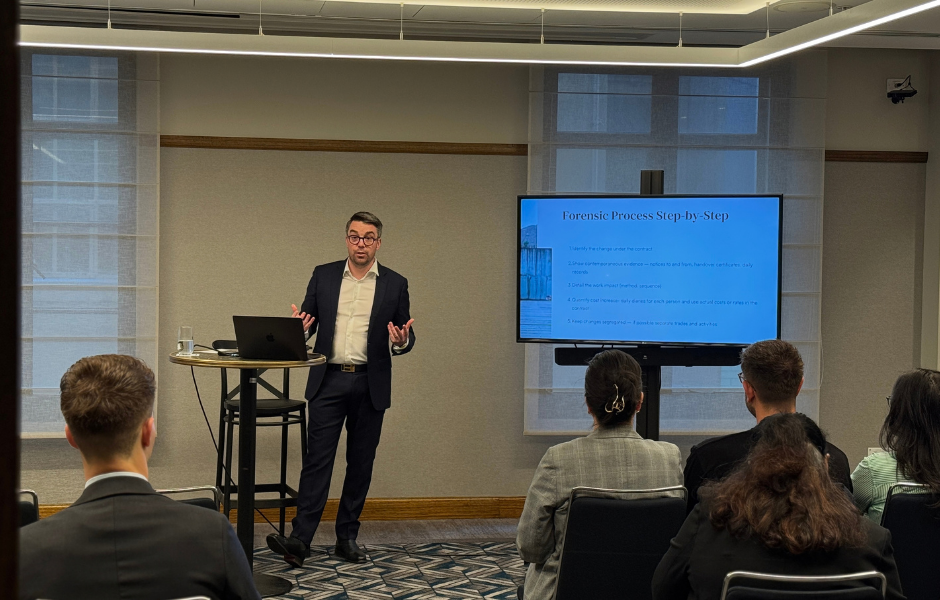
When a construction project falls behind, establishing what caused the delay, who is responsible and what can be claimed requires more than a programme showing late activities.
A credible delay claim needs a clear chain of causation, reliable project records, a defensible method of analysis and evidence that connects delay to the time and costs claimed.
In this practical seminar, Accura Consulting experts Paul McArd and Andrew McKenna will examine how delay entitlement and damages can be demonstrated in construction projects. Drawing on their experience in quantum, delay analysis and construction claims, they will explore the methods, evidence and common pitfalls that can determine whether a claim stands up to scrutiny.
The session will focus on real-world application, including what works, what tends to fail and how claims can be prepared more effectively.
Key Details
Date: Wednesday 11 November
Time: 5.45pm - 6.30pm (followed by drinks)
Location: 140 William Street, Melbourne, 3000
Presented by: Paul McArd and Andrew McKenna, Accura Consulting
Food and drinks provided
Secure Your Place
Leave us a few details below and we’ll be in touch soon.
Registrations close 5pm Friday 6 November.
What will the seminar cover?
Establishing delay and causation
1
Understand how to identify the delaying event, establish its contractual relevance and demonstrate the link between cause and effect. The session will examine critical and non-critical delay, prolongation and the treatment of concurrent delay.
Making the construction programme work for you
2
Explore the role of the approved baseline programme, programme logic, resource assumptions and regular progress updates. We will consider how a programme can support project management as events unfold, and how it can help demonstrate delay at the time it occurs.
Choosing the right delay analysis method
3
Gain an overview of prospective and retrospective delay analysis techniques, including time impact analysis, as-planned versus as-built and collapsed as-built approaches. The focus will be on selecting a method that is appropriate to the dispute, the project records and the questions that need to be answered.
Preparing a defensible claim
4
Examine how to structure a claim around entitlement, causation and quantum. This includes complying with contractual notice and substantiation requirements, building a concise chronology, organising supporting evidence and separating distinct heads of claim.
Consider how to define the compensable period and substantiate the costs associated with it. The discussion will cover labour, plant, time-related costs, direct costs and productivity data, including the risks of relying on unsupported formulae or broad assumptions.
Demonstrating prolongation and time-related costs
5
Lessons from real claims
6
Drawing on their experience, Paul and Andrew will discuss common problems encountered in delay and damages claims, why certain approaches fall short and how the evidence and analysis could be improved.
Our Team

Paul McArd - Quantum Expert
Managing DirectorPaul McArd is Managing Director of Accura Consulting and a specialist in forensic quantity surveying, quantum assessment and construction claims. A Fellow of the Royal Institution of Chartered Surveyors and the Australian Institute of Quantity Surveyors, Paul brings practical experience across major construction, infrastructure, energy and building projects in Australia and internationally.
Paul is a published thought leader on construction claims, quantum evidence and dispute strategy. His articles appear on Lexology, where he is recognised as a Future Leader in construction and arbitration, and in industry publications including Built Economist. He also writes the Construction Claims Newsletter, sharing practical commentary on cases, claims and the evidence required to support them.

Director - Delay and PlanningAndrew McKenna - Delay Expert
Andrew McKenna specialises in construction delay, planning and forensic delay analysis. He has provided written and oral expert evidence in formal proceedings in Australia and overseas, and is known for a clear, common-sense approach to explaining complex programme and causation issues.
Andrew regularly publishes analysis of construction delay decisions, programme methodology and the practical challenges of demonstrating delay. His work appears on Lexology and through his popular LinkedIn newsletter, Construction Delay Digest, which examines the cases, techniques and project records that matter when delay claims are tested.
Secure Your Place
Leave us a few details below and we’ll be in touch soon.
Registrations close 5pm Friday 6 November.